

Visualizzazione post con etichetta inferno. Mostra tutti i post
Visualizzazione post con etichetta inferno. Mostra tutti i post
lunedì 27 maggio 2019

sabato 24 marzo 2018
Anniversario della morte dell'infame e sanguinaria Elisabetta I Tudor, illegittima figlia dell'empio Enrico VIII
Come ci ricorda un nostro amico, il 24 marzo 1603, vigilia della festa dell'Annunciazione e dell'Incarnazione del Verbo (che quest'anno a causa della settimana santa è tuttavia spostata al 9 aprile), di Colei cioè che da sola sconfisse tutte le eresie, moriva Elisabetta I Tudor, figlia illegittima dell'empio Enrico VIII e di Anna Bolena, eretica, fautrice di eretici, nemica di Dio e della sua Chiesa, sanguinaria massacratrice di Cattolici, scomunicata e deposta da papa S. Pio V.
Così a lei si rivolgeva sant’Edmund Campion, gesuita martirizzato il 1º dicembre 1581:


Fonte: Luca Fumagalli, Edmund Campion: gesuita e martire, in Radiospada, 29.6.2016
Anni dopo, questa profezia di questo martire troverà la sua piena realizzazione.
Anni dopo, questa profezia di questo martire troverà la sua piena realizzazione.
Ella, dopo aver regnato 40 e passa anni, avendo per questo fatto anche un patto col Diavolo (è ciò è plausibilissimo stante le sue frequentazioni con l'esoterista John Dee, che stregone, teurgo, astrologo e negromante alla corte di Elisabetta, noto per evocare spiriti maligni con l'ausilio della cabala ebraica ai quali chiedeva consiglio in materia politica e bellica per conto della regina stessa), giace ora - secondo l'autorevole voce di S. Alfonso Maria de' Liguori - all'Inferno, rimpiangendo quello scellerato patto ed aver buttato la sua vita per l'eternità in cambio della vanità del regno:
"Il terzo rimorso del dannato sarà il vedere il gran bene, che ha perduto. Dice S. Giovanni Grisostomo che i presciti saranno più tormentati dalla perdita fatta del paradiso, che dalle stesse pene dell'inferno: «Plus coelo torquentur, quam gehenna». Disse l'infelice principessa Elisabetta regina d'Inghilterra: Diami Dio quarant'anni di regno, ed io gli rinunzio il paradiso. Ebbe la misera questi quarant'anni di regno, ma ora che l'anima sua ha lasciato questo mondo, che dice? certamente che non la sente così; oh come ora se ne troverà afflitta e disperata, pensando che per quarant'anni di regno terreno, posseduto fra timori ed angustie, ha perduto eternamente il regno del cielo." (Apparecchio alla morte, Cons. XXVIII, Punto III).

 |
| Autore sconosciuto, Ritratto di Elisabetta con serpente, 1580-90, National Gallery, Londra. V. QUI |

 |
| Paul Delaroche, Morte di Elisabetta I, regina d'Inghilterra, 1828, Museé du Louvre, Parigi |
sabato 18 febbraio 2017
Mons. Schneider: "Lutero non è un testimone del Vangelo" (stralcio dell'intervista per Rorate caeli). In morte dell'eresiarca tedesco
Il 18 febbraio 1546 moriva suicida l’eretico Martin Lutero, dopo
una notte di gozzoviglie. Vi sono varie “testimonianze”, protestanti e cattoliche,
su questo ultimo gesto disperato di Lutero.
Qui, ci basti ricordare la principale; quella del suo servo personale,
Ambrogio Kuntzell (o Kudtfeld) il quale, colpito nell’animo da quel terribile
castigo di Dio sul suo padrone, finì col confessare tutte le particolarità! Ecco
la sua testimonianza: «Martin Lutero, la sera prima della sua morte, si lasciò
vincere dalla sua abituale intemperanza e con tale eccesso che noi fummo
obbligati a portarlo via, del tutto ubriaco, e coricarlo nel suo letto. Poi, ci
ritirammo nella nostra camera, senza nulla presagire di spiacevole! All’indomani,
noi ritornammo presso il nostro padrone per aiutarlo a vestirsi, come d’uso.
Allora - oh, quale dolore! - noi vedemmo il nostro padrone Martino appeso al
letto e strangolato miseramente! Aveva la bocca contorta, la parte destra del
volto nera, il collo rosso e deforme. Di fronte a questo orrendo spettacolo,
fummo presi tutti da un grande timore! Non di meno corremmo, senza alcun
ritardo, dai Prìncipi, suoi convitati della vigilia, ad annunziare loro quell’esecrabile
fine di Lutero! Costoro, colpiti dal terrore come noi, ci impegnarono subito,
con mille promesse e coi più solenni giuramenti, ad osservare, su quell’avvenimento,
un silenzio eterno, e che nulla di nulla fosse fatto trapelare. Poi, ci
ordinarono di staccare dal capestro l’orribile cadavere di Lutero, di metterlo
sul suo letto e di divulgare, dopo, in mezzo al popolo, che il “maestro Lutero”
aveva improvvisamente abbandonata questa vita»! Questo è il racconto della
morte-suicida di Lutero, fatta dal suo domestico Kudtfeld; un “racconto” che fu
pubblicato, ad Anversa, nel 1606, dallo scienziato Sédulius. Il dottor de Coster
- subito chiamato! - fu lui che constatò che la bocca di Lutero era contorta,
che la parte destra del suo viso era nera e che il collo era rosso e deforme,
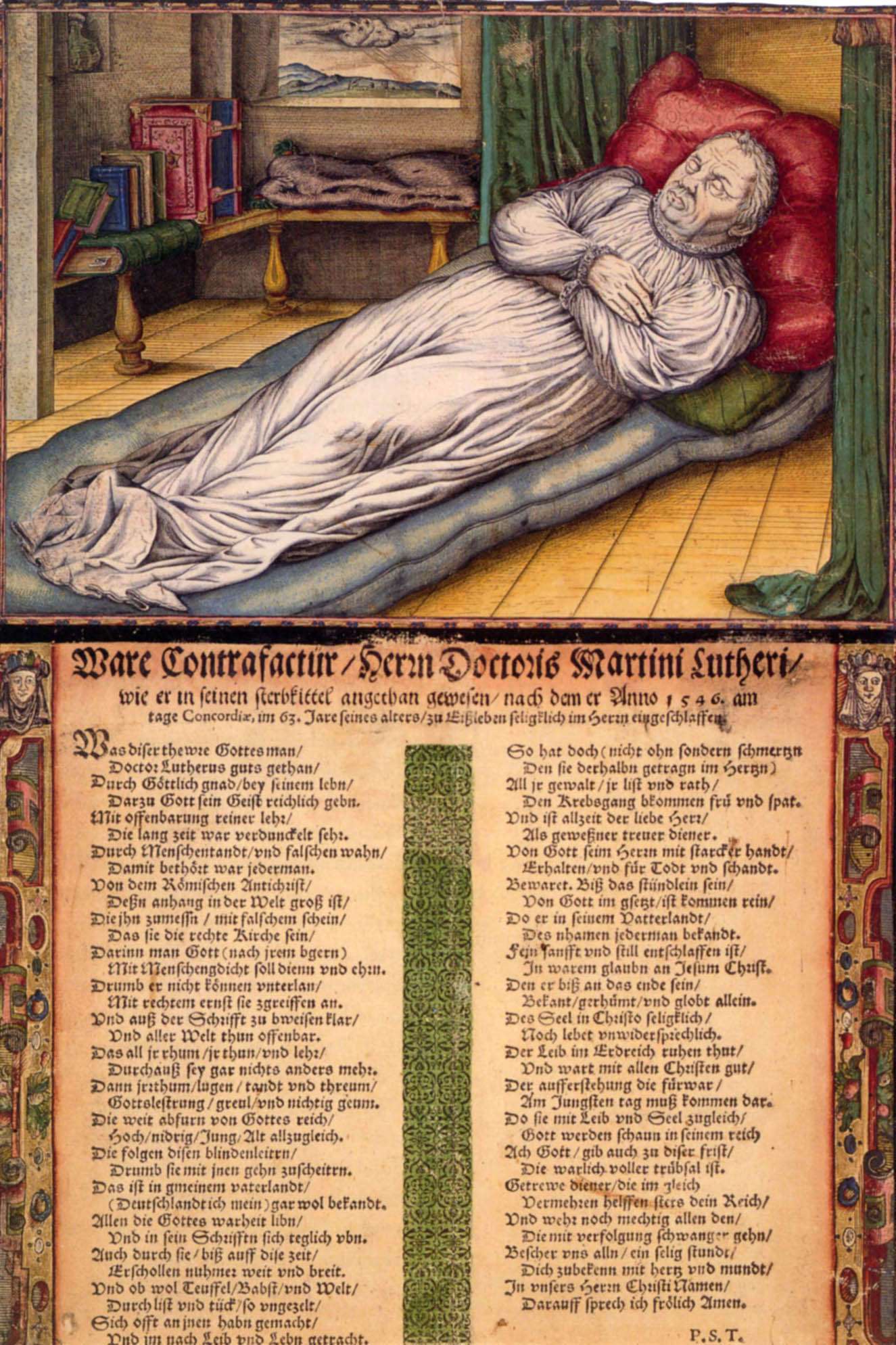
come se fosse stato appunto strangolato. Questa sua diagnosi la si può
verificare su una incisione che Lucas Fortnagel fece subito il giorno dopo la
morte di Lutero, e che fu pubblicata da Jacques Maritain nella sua opera: Tre riformatori,
a pagina 49 (dell’edizione francese). Lutero, quindi, non morì di morte
naturale, come si è falsamente scritto su tutti i libri di storia del protestantesimo,
ma morì “suicida” nel suo stesso letto, dopo una lautissima cena in cui, come
al solito, aveva bevuto smisuratamente e si era rimpinzato di cibo oltre ogni
limite! Sopra il suo letto, un giorno, egli vi aveva scritto: «Papa, da vivo
ero la tua PESTE; da morto sarò la tua MORTE»! (Pestis eram vivus, moriens
ero mors tua).
Del resto, come poteva morire se non in modo così disperato chi
aveva in orrore anche solo il leggere il canone della Messa e che il giorno
della sua stessa ordinazione sacerdotale, mentre il suo Vescovo gli conferiva
la potestà di consacrare (Accipe potestatem sacrificandi pro vivis et
mortuis), si augurava che la terra l’inghiottisse (così ricorda Jacques Maritain, Tre riformatori.
Lutero, Cartesio, Rousseau, Morcelliana, Brescia, 20018, con Introduzione
di Antonio Pavan e Prefazione
di Giovanni Battista Montini, pp.
52-53)?
Nonostante la sua morte suicida, non crediate che sia in Paradiso
a godere il pegno dei giusti. Egli, infatti, giace all’Inferno, tormentato di
continuo dai demoni, dopo aver rifiutato l’ultima ancora di salvezza che Dio
gli aveva offerto. Come abbiamo già ricordato in altra occasione (v. qui).
A questo riguardo assai interessante è il dialogo – vero – tra
Lutero e la moglie, la ex monaca Katharina von Bora, come ci è riportata da uno
storico, al di sopra di ogni sospetto quale fu Jean-Marie-Vincent Audin, nella
sua Storia della vita di Martin Lutero. Ecco la traduzione italiana:
«Una sera, le stelle scintillavano di straordinario splendore, il cielo sembrava
di fuoco … - Osserva come quei punti luminoso risplendono, disse Caterina a
Lutero … Lutero alzò gli occhi – Oh! che viva luce! disse, essa non risplende
per noi! – E perché? soggiunse Bora, forse che saremmo privati del regno de’
cieli? Lutero sospirò … - Forse, disse, per punirci perché abbiamo abbandonato
il nostro stato - Bisognerebbe dunque ritornarvi? suggiunse Caterina. – È
troppo tardi, il carro è impantanato, replicò il dottore, e ruppe il colloquio»
(Jean-Marie-Vincent Audin, Storia
della vita, delle opere e delle dottrine di Martino Lutero, vol. II, Milano 1842, p. 126. Nella versione francese, Id., Histoire de la vie, des écrits e
des doctrines de Martin Luther, vol. II, Paris 1841, p. 278). Lutero
aveva, dunque, rimorsi di coscienza per aver abbandonato i suoi voti? Dio,
dunque, nella sua infinita misericordia, aveva offerto all’eresiarca un’ultima
ancora di salvezza, nella speranza che lo spettacolo del cielo lo inducesse a
pentimento ed a resipiscenza per il male commesso, per i voti infranti e per
essere stato causa, con le sue empie, dottrine, della dannazione di molte genti
ed intere generazioni di uomini.
Che sia dannato, poi, non lo diciamo noi. Ce l’attestano i mistici.
Una di queste, come ricordavamo in altre occasioni, fu la Beata Maria Serafina
Micheli, elevata agli onori degli altari nel maggio 2011 (v. qui
e qui).
Come ci racconta don Marcello Stanzione (v. Suor Serafina Micheli e
la visione di Lutero all’Inferno, in Milizia
di San Michele, nonché La posizione di Martin Lutero all’inferno/
Extra Ecclesiam nulla salus, in Radiospada,
24.8.2012), nel 1883, la mistica si trovava a passare per Eisleben, nella
Sassonia, città natale di Lutero. Si festeggiava, in quel giorno, il quarto
centenario della nascita del grande eretico (10 novembre 1483), che spaccò l’Europa
e la Chiesa in due, perciò le strade erano affollate, i balconi imbandierati.
Tra le numerose autorità presenti si aspettava, da un momento all’altro, anche
l’arrivo dell’imperatore Guglielmo I, che avrebbe presieduto alle solenni
celebrazioni. La futura beata, pur notando il grande trambusto non era interessata
a sapere il perché di quell’insolita animazione, l’unico suo desiderio era
quello di cercare una chiesa e pregare per poter fare una visita a Gesù
Sacramentato. Dopo aver camminato per diverso tempo, finalmente, ne trovò una,
ma le porte erano chiuse. Si inginocchiò ugualmente sui gradini ... d’accesso,
per fare le sue orazioni. Essendo di sera, non s’era accorta che non era una
chiesa cattolica, ma protestante. Mentre pregava le comparve l’angelo custode,
che le disse: “Alzati, perché questo è un tempio protestante”. Poi le
soggiunse: “Ma io voglio farti vedere il luogo dove Martin Lutero è condannato
e la pena che subisce in castigo del suo orgoglio”. Dopo queste parole vide un’orribile
voragine di fuoco, in cui venivano crudelmente tormentate un incalcolabile
numero di anime. Nel fondo di questa voragine v’era un uomo, Martin Lutero, che
si distingueva dagli altri: era circondato da demoni che lo costringevano a
stare in ginocchio e tutti, muniti di martelli, si sforzavano, ma invano, di conficcargli
nella testa un grosso chiodo. La suora pensava: se il popolo in festa vedesse
questa scena drammatica, certamente non tributerebbe onori, ricordi,
commemorazioni e festeggiamenti per un tale personaggio. In seguito, quando le
si presentava l’occasione ricordava alle sue consorelle di vivere nell’umiltà e
nel nascondimento. Era convinta che Martin Lutero fosse punito nell’Inferno
soprattutto per il primo peccato capitale, la superbia.
Vanno perciò rigettati, in quanto erronei, contrari alla fede,
maleodoranti, perniciosi, storicamente falsi, che portano all’esaltazione di un’anima
reproba ed al danno di tante anime, tutti quegli insegnamenti “magisteriali”,
che dipingono l’eresiarca come un sincero cercatore di un rinnovamento
spirituale della Chiesa, come un una persona profondamente religiosa che ardeva
di ansia apostolica per la salvezza delle anime (forse chi lo dice dimentica i Discorsi
conviviali dell’eresiarca … o che aveva avallato la bigamia: v. qui)
o come personaggio il cui pensiero sarebbe asseritamente cristocentrico, un
personaggio che aveva idee cattoliche, ecc. (su queste ed altri insegnamenti “magisteriali”
sull’eresiarca, in piena continuità tra loro, cfr. Lutero e la Riforma:
Bergoglio in continuità con Wojtyla e Ratzinger, in UCCRline.it,
16.2.2017). Nulla di più fallace ed erroneo. Non foss’altro perché – come ricordato
con un aforisma in altra
occasione - anche Lucifero aveva buone intenzioni (dal suo punto di vista
ovviamente) ed iniziò bene: era un eccelso angelo! Pure Giuda Iscariota iniziò
bene: era un discepolo prescelto da Gesù stesso! Pure Ario o Nestorio iniziarono
bene (l’uno era prete e l’altro patriarca di Costantinopoli) ed avevano –
inizialmente – idee cattoliche … . Chi dice questo non ha inteso che,
nella logica del Vangelo, non è detto che chi inizia bene, finisca parimenti
bene. Anzi, è vero il contrario. Nella storia della Chiesa, molti Santi hanno
iniziato la vita da grandi peccatori, per poi finire bene. È la logica degli
operai dell’ultim’ora.
Non a caso, peraltro, la Chiesa ha sempre invitato i fedeli ad
invocare da Dio il dono della perseveranza finale, poiché il momento della
morte è quello decisivo, più importante persino della nascita: è quello in cui
ci si gioca l’eternità. Poco importa – dinanzi a Dio – cosa si sia stati in
vita: ciò che conta è come ci si trovi, in rapporto a Dio, al momento della
morte. Per questo, invochiamo la Vergine, nell’Ave Maria, di pregare per noi «adesso
e nell’ora della nostra morte» (nunc et in hora mortis nostrae), stante
la decisività di quell’istante finale nel quale è in gioco l’eternità.
Nel giorno della morte dell’eresiarca, perciò quanto mai appropriato
è questo stralcio dell’intervista a Mons. Schneider, nel quale – in maniera
chiara – ricorda come Lutero non possa essere definito un testimone del
Vangelo. L’intervista è riportata in Rorate
caeli, Feb. 16, 2017.
 |
| Lucas Cranach il Giovane, Lutero sul letto di morte, 1546, Niedersächsisches Landesmuseum, Hannover. Il collo di Lutero appare rigonfio e livido: chiaro sintomo della sua morte da soffocamento |
 |
| Katharina von Bora in abito da lutto, 1546 |
Martin
Luther is Not A Witness to the Gospel Bishop Schneider on Vatican Document

CFN Intro: On
February 16 Rorate Caeli and Adelante la Fe posted a comprehensive video interview with the well-known conservative
Bishop Athanasius Schneider of Kazakistan that runs about 48 minutes. The
interview covered a myriad of topics, but CFN is spotlighting Bishop Schneider’s
magnificent response regarding a recent Vatican document that names the
heresiarch Martin Luther as a witness to the Gospel. We know you will benefit
from Bishop Schneider’s forthright commentary (JV).
Question: A controversial document from the Pontifical Council for Christian Unity
equates Saint Ignatius of Loyola and Saint Francis of Borgia with Martin
Luther, calling him a witness to the Gospel. We as Catholics are aware of the serious
damage Luther caused to the Church, what should be our position if our
ecclesiastical authorities invite us to consider Luther as a witness to the
Gospel?
Bishop
Schneider. Well,
this document is issued by the Pontifical Council for Christian Unity, this
Council has no doctrinal authority. We have no need to take seriously this
document, which is objectively wrong. It is against the evidence. We cannot put
on the same level Luther and Saint Ignatius. This is a contradiction. Luther cannot
be a witness to the Gospel, and the Church will not ask us to accept this
because it is only a statement from the pontifical Council so it need not be
taken seriously.
When we examine
in sincerity and honesty Luther and his work, he caused immense damage to the
entire Christianity. He divided Christianity. He is not a witness of the
Gospel. He denied almost the entire previous tradition from 1500 years. This
cannot be a witness to the Gospel who puts himself as the authority to
interpret the Word of God. This is against the Faith which Christ gave us and
which the apostles transmitted to us in a basic manner – to reject the
Holy Tradition as really a fount of revelation and the entire thinking of the
Church which the Holy Ghost guided in the dogmatic and doctrinal issues, and
this is the case. Luther did not reject [merely] the disciplinary tradition,
the pastoral tradition, but he rejected the fundamental doctrinal tradition of
the Church. And the doctrinal tradition of the Church is the Gospel. This is Gospel. And when I reject the substance
of the entire Apostolic and immutable constant tradition of the Church (in the
case of Luther, 1500 years) I am rejecting the Gospel.
For example,
in Kazakistan where I am living there was a holy martyr priest who was
beatified, Blessed Oleksa Zarytsky whom my parents had known personally, he
blessed me when I was a child. This priest was from the Byzantine Rite, but
Catholic. And the Communist asked them not to deny Christ, not to deny the sacraments,
but only to deny one point of the Gospel: the primacy of Peter, the papacy
(which is in the Gospel). Blessed Oleksa told the tribunal, “If I would deny
this point on the primacy of Peter, I will deny entire Gospel. I will be the
anti-witness of the entire Gospel.” This is in our time, he died in 1963.
So, in the
case of Luther, he rejected the heart of the Church, which is the Eucharist. He
rejected the sacrificial essence and substance of the Eucharistic celebration,
and this is the heart of the Church – the Eucharist. This is just one example.
So how could one be a witness to the Gospel when he rejects the heart of the
Church, the sacrificial nature of the Mass itself?
Luther
called the Mass an invention of the devil, a blasphemy. He called the papacy an
invention of satan. How can we name this person as a witness? When we do this,
we don’t believe in the sacrificial character of the Mass, or we don’t believe
in the primacy of Peter, or we don’t believe in the Catholic manner of the
unchangeable doctrinal tradition of the Church, or we are committing a lie and
playing only a game of political correctness. This is very dishonest. Or we
have an intellectual position of relativism, that truth and untruth are the
same. And so in this case when this document from the Pontifical Council states
that Luther is more or less the same level as St. Ignatius, they are putting
truth and error at the same level. This is the position of philosophical and
theological relativism. And this is very dangerous.
So I think
we need not take this document seriously, because it has no doctrinal
authority. It is in itself contradictory and completely wrong. This document
will not last for many years. Because the Church is more powerful, the unchangeable
truth is more powerful than this weak and very wrong document. It will pass
away with time.
Fonte: Catholic Family News, Feb. 17, 2017
Fonte: Catholic Family News, Feb. 17, 2017
domenica 21 agosto 2016

venerdì 5 agosto 2016

lunedì 4 luglio 2016

domenica 1 maggio 2016

sabato 31 ottobre 2015
Dio, misericordia, peccato, Inferno, dannazione in un aforisma di S. Alfonso M. de' Liguori, tratto dal suo "Apparecchio alla morte"

S. Alfonso M. de’ Liguori, Apparecchio alla morte, Considerazione
XXIII, Inganni che ‘l Demonio mette in mente a’ peccatori, punto II

martedì 31 marzo 2015
Bugie sul destino di Giuda ......
Durante la Settimana Santa, la vicenda terrena ed umana
di Gesù si incrocia con le vicende – minori – di altri protagonisti. Abbiamo la
Vergine Maria assieme a San Giovanni; San Pietro; Pilato, Caifa, Erode, i
soldati. Ma soprattutto si erge, in maniera inquietante, la figura di Giuda l’Iscariota.
Molto si è detto di questo personaggio. San Luca,
allorché fa l’elenco dei discepoli di Gesù, lo indica «Giuda Iscariota, che
fu il traditore» (Luc. 6, 16). San Matteo e San Marco, invece, dicono di
lui «Giuda l'Iscariota, che poi lo tradì» (Matth. 10, 4) «Giuda
Iscariota, quello che poi lo tradì» (Marc. 3, 19). Significativo è quel «che
poi lo tradì» a voler dire che Giuda, quando fu prescelto da Gesù, non
aveva in animo di tradirlo; anzi sicuramente non ci aveva neppure pensato ad un
tradimento del Signore.
Perché, dunque, tradì Gesù?
Senz’altro fu un’opera diabolica.
Gli Evangelisti sono concordi sul punto. L’apostolo
Giovanni ricorda, parlando dell’Ultima Cena: «mentre cenavano, quando già il
diavolo aveva messo in cuore a Giuda Iscariota, figlio di Simone, di tradirlo, …»
(Johan. 13, 2). Analogamente Luca (Luc. 22, 3).
Gli altri due Vangeli Sinottici ricollegano, invece, il motivo
del tradimento all’unzione a Betania, presso la casa di Simone il lebbroso. L’episodio
è noto: in quella circostanza, una donna aveva unto con del nardo genuino di
gran valore il capo di Gesù. Un apostolo – che san Giovanni identificherà in
Giuda – si lamenta dello “spreco” e che dello stesso si poteva vendere ed
offrire il ricavato ai poveri. Gesù redarguì l’Iscariota, elogiando il gesto di
delicatezza della donna. A causa di questo rimprovero, Giuda – secondo Matteo e
Marco – si sarebbe recato dai sommi sacerdoti per accordarsi con loro sulla
consegna del Maestro (Matth. 26, 14; Marc. 14, 10 ss.). Giovanni spiega che
Giuda rimproverò la donna «non perché gl'importasse dei poveri, ma perché
era ladro e, siccome teneva la cassa, prendeva quello che vi mettevano dentro»
(Johan. 12, 6).
Dunque, il tradimento fu senz’altro un’opera del demonio,
il quale trovò la strada di entrare in Giuda “solleticando” la sua avidità per
il denaro.
Ma proprio questo fu la sua rovina.
Alcuni moderni esegeti tendono ad attenuare la condotta
di Giuda, insinuando l’idea che non fosse libero e che, in un certo senso,
fosse stato “costretto” a tradire il Maestro, perché senza di lui non si sarebbe
potuto compiere il sacrificio. Per questo, tendono ad esaltare la figura del
Traditore, non escludendo che possa persino essersi … salvato … .
Come fu per Pietro, anche a Giuda fu offerta la salvezza;
fu offerto il pentimento. Giuda, infatti, tornato indietro sui suoi passi dopo
aver visto la condanna di Gesù da parte del Sinedrio, confessò: «Ho peccato,
perché ho tradito sangue innocente» (Matth. 27, 4).
Ma non ebbe la forza, dopo la confessione, di chiedere
perdono al Signore. Per questo andò ad impiccarsi (Matth. 27, 5).
San Pietro per questo poté dire: «Fratelli, era
necessario che si adempisse ciò che nella Scrittura fu predetto dallo Spirito
Santo per bocca di Davide riguardo a Giuda, che fece da guida a quelli che
arrestarono Gesù. Egli era stato del nostro numero e aveva avuto in sorte lo
stesso nostro ministero. Giuda comprò un pezzo di terra con i proventi del suo
delitto e poi precipitando in avanti si squarciò in mezzo e si sparsero fuori
tutte le sue viscere. La cosa è divenuta così nota a tutti gli abitanti di
Gerusalemme, che quel terreno è stato chiamato nella loro lingua Akeldamà, cioè
Campo di sangue» (Act. 1, 16-19). Quando poi si dové decidere della
sostituzione, in seno al Collegio dei Dodici, si pregò riguardo a chi scegliere
al posto di Giuda per il posto che egli aveva «abbandonato per andarsene al
posto da lui scelto» (Act. 1, 25) alludendo che il posto da lui scelto
fosse … l’Inferno.
Quest’interessante contributo in inglese ci offre la
possibilità di riflettere su questa figura del Nuovo Testamento.
Damned
Lies:
On the Destiny of Judas Iscariot

From the
traditional Collect for Holy Thursday (Missale Romanum 1962),
it is clear past all doubt that the centuries-old lex orandi of the Church teaches that Judas is
lost, condemned forever to the fires of hell:
O God, from whom Judas received the punishment of his guilt, and the thief the reward of his confession: grant unto us the full fruit of Thy clemency; that even as in His Passion our Lord Jesus Christ gave to each retribution according to his merits, so having cleared away our former guilt, he may bestow on us the grace of His resurrection: Who with Thee liveth and reigneth…
This
conclusion was once taken for granted by everyone. Why, then, do so many people
nowadays say that we “do not know” about Judas’s final destiny? To show that I
am not exaggerating, take the former Father Thomas Williams of the Legionaires
of Christ, in a ZENIT interview:
Historically, many have thought that Judas is probably in hell, because of Jesus’ severe indictment of Judas: “It would be better for that man if he had never been born,” as he says in Matthew 26:24. But even these words do not offer conclusive evidence regarding his fate. In his 1994 book, Crossing the Threshold of Hope, Pope John Paul II wrote that Jesus’ words “do not allude for certain to eternal damnation.”
The
Witness of Scripture
But does
this position make any sense? Consider it, first, simply from the Scriptural
evidence. Our Lord says: “The Son of man indeed goeth, as it is written of him:
but woe to that man by whom the Son of man shall be betrayed: it were
better for him, if that man had not been born” (Mt 26:24). Now, of a
man who falls into mortal sin but then repents—such as Peter, who also betrayed
Christ, or Saul, who persecuted Jesus by hunting down Christians—it is impossible to say “it were better for him if he
had not been born,” that is, “if he had never existed at all.” For it is only
those who are condemned to suffer eternally the unspeakable torments of hell of
whom it can be said with any truth: it were better for them if they had never
existed. On the contrary, a mortal sinner who repents brings joy to the angels
(Lk 15:10) and inherits the kingdom of heaven; he is not an object of “woe,”
and it is eminently good that such
a man be born, for he can then assume an office like that of the first Pope or
of the Apostle to the Gentiles, and after death he will enjoy the beatific
vision forever. So the only way Jesus’ words can be true is if Judas is lost
due to unrepented mortal sin.
All this
squares, of course, which what is narrated of Judas’s death: “And casting down
the pieces of silver in the temple, he departed: and went and hanged himself with a halter” (Mat 27:5)—that is, he
made a gesture of despair, and then committed suicide, which is a mortal sin.
Such an end was fitting to the only close follower of Jesus characterized in
the Gospels as given over to the devil: “And Satan entered into Judas, who was
surnamed Iscariot, one of the twelve” (Lk 22:3); “And after the morsel, Satan
entered into him” (Jn 13:27).
Saint
Peter bears witness to this understanding of Judas’s death and damnation in the
first chapter of the Acts of the Apostles:
Men, brethren, the scripture must needs be fulfilled, which the Holy Ghost spoke before by the mouth of David concerning Judas, who was the leader of them that apprehended Jesus: who was numbered with us, and had obtained part of this ministry. And he indeed hath possessed a field of the reward of iniquity, and being hanged, burst asunder in the midst: and all his bowels gushed out. … For it is written in the book of Psalms: Let their habitation become desolate, and let there be none to dwell therein. And his bishopric let another take. (Act 1:16-20)
After two
candidates are put forth, Joseph and Matthias, the account continues:
And praying, they said: Thou, Lord, who knowest the hearts of all men, shew whether of these two thou hast chosen, to take the place of this ministry and apostleship, from which Judas hath by transgression fallen, that he might go to his own place. (Act 1:24-25)
The first
Pope argues that Judas, by his transgression, fell away from the apostleship
forever. Note that Judas was the only apostle
whose place had to be filled after his death. When James was killed by Herod
(Acts 12:2), Peter and the others did not appoint another man as a James
substitute. There were successors to
the apostles (and many more than twelve of them!), but no other replacements. Ultimately, all of the original
eleven together with Matthias left this world in death to become the
everlasting foundations of the heavenly Jerusalem: “And the wall of the city
had twelve foundations, and in them, the twelve names of the twelve apostles of
the Lamb” (Rev 21:14). Put simply, an apostle who died in a state of grace is
an apostle forever, irreplaceable, going to his reward as a perrmanent
foundation stone of the Church. This can only mean that Judas, who had to be replaced, died in sin and lost his
ministry and apostleship forever. He went “to his own place,” that is, the
place that befitted him: hell.
The
Witness of Fathers and Doctors

This
conclusion, which squares so well with the Scriptural evidence, is found
throughout the writings of the Fathers and Doctors of the Church. Of countless
testimonies, a few examples will suffice. Pope St. Leo the Great teaches that
Judas never repented of his grave sin—that he committed suicide out of despair,
adding guilt to guilt:
The traitor Judas did not attain to this mercy, for the son of perdition (Jn. 17:12), at whose right hand the devil had stood (Ps. 108:6), had before this died in despair; even while Christ was fulfilling the mystery of the general redemption. Even he perhaps might have obtained this forgiveness, had he not hastened to the gallowstree; for the Lord died for all evildoers. But nothing ever of the warnings of the Saviour’s mercy found place in that wicked heart: at one time given over to petty cheating, and then committed to this dread parricidal traffic. … The godless betrayer, shutting his mind to all these things [expressions of the Lord’s mercy], turned upon himself, not with a mind to repent, but in the madness of self-destruction: so that this man who had sold the Author of life to the executioners of His death, even in the act of dying sinned unto the increase of his own eternal punishment.(Sermon 62, De passione Domini XI [PL 54], in The Sunday Sermons of the Great Fathers, vol. 2, p. 183)
St.
Augustine holds exactly the same view:
For if it is not lawful to take the law into our own hands, and slay even a guilty person whose death no public sentence has warranted, then certainly he who kills himself is a homicide. … Do we justly execrate the deed of Judas, and does truth itself pronounce that by hanging himself he rather aggravated than expiated the guilt of that most iniquitous betrayal, since, by despairing of God’s mercy in his sorrow that wrought death, he left to himself no place for a healing penitence? … For Judas, when he killed himself, killed a wicked man, and passed from this life chargeable not only with the death of Christ, but also with his own: for though he killed himself on account of his crime, his killing himself was another crime. (The City of God, Bk. I, ch. 17)
From the
Eastern tradition, we have St. Ephrem the Syrian:
Judas was the treasurer of his [Satan’s] poison,And although Satan’s form is hidden,In Judas he is totally visible;Though Satan’s history is a long one,It is summed up in the Iscariot. (Hymns of Paradise XV, p. 187)
And St.
Ephrem once again:
O! of how many good things, of what joy are we deprived, when we are without charity? Judas scorned it, and he left the company of the Apostles. Abandoning the True Light, His own Master, hating his brethren, he walked out into the darkness. Because of this Peter, the Prince of the Apostles, says: “Judas hath by transgression fallen, that he might go to his own place” (Acts 1:25). And again John the Divine: “He that hateth his brother, he says, is in darkness, and walketh in darkness, and knoweth not where he goeth; because the darkness hath blinded his eyes” (1 Jn 2:11). (ed. Vossio, S. Eph., Tome 1, Sermo 5, on Matt. 11:29)
St.
Thomas Aquinas writes: “To save Judas would … be contrary to [God’s]
foreknowledge and disposition, by which He prepared for him
eternal punishment; hence it is not the order of justice [as such]
that renders impossible Judas’s salvation, but the order of eternal
foreknowledge and disposition” (In IV Sent., dist.
46, qu. 1, art. 2, qa. 2, ad 3), and says matter-of-factly:
As the use of grace is related to the final effect of predestination, so the abuse of it is related to the effect of reprobation. Now, in the case of Judas, the abuse of grace was the reason for his reprobation, since he was made reprobate because he died without grace. Moreover, the fact that he did not have grace when he died was not due to God’s unwillingness to give it but to his unwillingness to accept it—as both Anselm and Dionysius point out. (De veritate, q. 6, art. 2, obj. 11: this part of the objection Thomas holds as true.)
And the
Seraphic Virgin St. Catherine of Siena, in her usual no-nonsense way, does not
beat around the bush:
This is the sin which is never forgiven, now or ever: the refusal, the scorning, of my mercy. For this offends me more than all the other sins they have committed. So the despair of Judas displeased me more and was a greater insult to my Son than his betrayal had been. Therefore, such as these are reproved for this false judgment of considering their sin to be greater than my mercy, and for this they are punished with the demons and tortured eternally with them. (The Dialogue, n. 37, Paulist ed., p. 79)
It should
seem obvious that Judas is lost, for two reasons: first, the words of Jesus
make no sense otherwise; second, he is depicted as killing himself in despair,
which is a mortal sin (despair, one of the worst) leading to another mortal sin
(suicide). The Church in the past did not even allow suicides to be buried in
church grounds because it was taken for granted that anyone who could hate the
gift of life enough to snub it out obviously could not have the love of God in
his heart. Nowadays we are more attentive to the psychological confusion and
anarchy that many people, especially in the modern world, can be trapped in,
but this does not make suicide neutral or inoffensive. It remains objectively
the gravest sin against human life, because it is a sin directed against the
person’s very own life, for which he has been given the deepest natural love
(“love your neighbor as yourself”). The
one who commits suicide in a state of despair is rejecting the very basis for
the love of any other person, human or divine.
Contemporary
Theology
Let us
return to contemporary theology. If it is possible that Judas is not in hell,
would there not be an equally good reason to ask, quite sincerely, if anyone is in hell? This brings us, of course, to
Hans Urs von Balthasar’s infamous question: “Dare we hope that all men be
saved?”
In
answering his question affirmatively, Balthasar makes a mockery of the whole
sweep of unanimous Christian commentary on the Gospels from the apostolic age
onwards and calls into question something that, for anyone who reads the
very words of the Gospels and Epistles, would be a certainty: that there is a hell and that souls do go down to it—Judas’s
and vastly many more, as Our Lady of Fatima showed the children.
Given his
own legerdemain, had Balthasar any right to complain when his contemporaries
went about deconstructing the Gospels and the life of Christ? He himself had
taken a doctrine that is utterly clear in its
meaning—no empty threats of eternal punishment, but the really existing thing
being spoken of as quite real and utterly certain for all who do not repent—and
made it liquid, open-ended, full of question-marks. Once this sort of
sophistical maneuvering is admitted, what happens to the Virgin Birth or the
Resurrection or even the Divinity of Christ?
We are dealing
here with just one more instance of how the Church today has gotten utterly
confused by relativistic modern thinking instead of following in the hallowed
footsteps of the great Fathers and Doctors. Those who are blessed to assist at
the traditional Latin Mass are formed by the sound and stable doctrine with
which the liturgy is suffused and to which it gives accurate and perennial
witness. The preaching associated with the ancient Mass more often than not
contains salutary reminders that the fear of the Lord is the beginning of
wisdom, that we should fear not the one who can destroy the body but the One
who can condemn the soul, that our eternal destiny is eternal happiness or
endless misery.
In the
ambit of the Mass of the ages, the lunacy of denying that there are many souls
in hell, and more joining them each day, is nowhere to be found. We do not
change the liturgy to suit our changing theology, cutting and pasting,
scribbling and scratching out. Rather, we gratefully receive and humbly accept
all that is handed down to us in the sacred liturgy—all of it, including the
Collect for Holy Thursday. Tradition is our stable ground, our faithful
interpreter of the Gospel of Christ the Lord.
domenica 8 febbraio 2015
In memoria della regina martire Mary Stuart
L’8 febbraio 1587, il giorno
fissato per l’esecuzione, presso il castello di Fotheringhay, Mary Stuart,
italianizzato come Maria Stuarda, riferiscono le fonti, entrò nel salone, in
cui doveva svolgersi la sua esecuzione, con aria tranquilla, indossando un
abito scuro e un lungo velo bianco, simile a quello di una sposa. Quando il
boia le presentò le sue scuse, ella gli disse: «Vi perdono con tutto il mio
cuore, perché spero che ora porrete fine a tutte le mie angustie». Sul patibolo
le sue dame, Elizabeth Curle e Jane Kennedy, l’aiutarono a spogliarsi, rivelando un sottabito rosso cremisi, il colore della
passione dei martiri cattolici, appositamente scelto dalla regina, che davanti
ai protestanti inglesi voleva morire da martire cattolica. Una volta bendata e
posizionata la testa sul ceppo pronunciò le parole: «In manus tuas, Domine,
commendo spiritum meum», cioè «Signore, nelle tue mani affido il mio
spirito».
Il
martirio della regina, stando ai testimoni, fu particolarmente brutale: il
primo colpo di mannaia fracassò parzialmente la nuca, gli astanti dissero che
in quel momento Maria aveva sussurrato le parole: «Dolce Gesù». Il secondo
colpo recise completamente il collo, fatta eccezione per un tendine, che fu
infine tagliato usando la scure come una sega (cfr. Antonia Fraser, Maria Stuart. La tragedia di una regina,
Mondadori, Milano 1998, p. 591). Quando gli esecutori si avvicinarono al corpo
senza vita per prendere gli ultimi ornamenti rimasti, prima che venisse
imbalsamato, la gonna di Maria iniziò a muoversi e dal di sotto uscì il piccolo
cane della regina, che ella era riuscita a nascondere sotto le lunghe vesti. Per quanto si cercasse di
allontanarlo, il cagnolino continuava a rimanere vicino al corpo (Stefan Zweig, Maria Stuarda. La
rivale di Elisabetta I d’Inghilterra, Bompiani, Milano 2013, p. 366). Le
dame della regina, alla fine, riuscirono a farlo desistere e lo lavarono più
volte per far andare via il sangue ma, una settimana più tardi, essendosi
rifiutato di mangiare, morì d’inedia (Fraser,
op. cit., p. 592). Il boia sollevò la testa della regina per mostrarla
ai presenti e in quel momento la folla fu sconvolta da un’inaspettata visione:
i riccioli castani di Maria si staccarono e la testa rotolò a terra; nessuno
avrebbe immaginato che la regina di Scozia indossasse una parrucca. A causa
delle sofferenze patite in prigionia, in effetti, Maria era precocemente
entrata in menopausa e i suoi capelli si erano incanutiti e diradati; per
ovviare a ciò, aveva preso l’abitudine di indossare una parrucca del suo colore
naturale (ibidem, p. 591; Zweig,
op. loc. cit.).La richiesta di Maria di essere sepolta in Francia venne
rifiutata da Elisabetta. Il suo corpo venne imbalsamato e lasciato insepolto in
una bara di piombo fino alla sua sepoltura, avvenuta nella Cattedrale di
Peterborough alla fine del luglio del 1587. Le sue interiora, rimosse come
parte del processo di imbalsamazione, furono sepolte in segreto nel castello di
Fotheringhay. Il suo corpo fu riesumato nel 1612 quando suo figlio, il re
Giacomo I d’Inghilterra, ordinò che venisse sepolta nell’Abbazia di
Westminster, in una cappella di fronte alla tomba di Elisabetta I.
 |
| Sentenza di condanna firmata da Elisabetta I |
 |
| Scipione Vannutelli, Maria Stuarda si avvia al patibolo, 1861, Galleria d'Arte Moderna, Firenze |
La regina di Scozia, regina consacrata da Dio,
moriva all’età di quarantaquattro anni. Il suo dramma ispirerà, nella musica, Donizetti
e Mercadante; nella letteratura l’Alfieri e Schiller.
La
regina martire poteva vantare inoltre una corrispondenza ed amicizia con San
Carlo Borromeo e godeva dell’appoggio di San Pio V.
Elisabetta,
sua cugina, morirà nubile, non ebbe figli ed il figlio di Maria, Giacomo Stuart
di religione protestante (e che aveva tradito per il trono la fede cattolica della
madre), divenne re d’Inghilterra, designato da Elisabetta sul letto di morte.
Dell’empia
Elisabetta, Sant’Alfonso Maria de’ Liguori, Dottore della Chiesa, ne parla nel
suo libro “Apparecchio alla morte”. Di lei scrive che questa, in maniera
stolta, arrivò a dire: «Dio, dammi quarant’anni di regno e io rinuncio al
paradiso!». Quella «misera», come la chiama il Santo Dottore, ebbe
effettivamente un regno di quarant’anni (per l’esattezza 45 anni), ma dopo la
morte fu vista di notte sulle sponde del Tamigi, mentre, circondata da fiamme,
gridava: «Quarant’anni di regno e un’eternità di dolore!...» (Apparecchio
alla morte, Considerazione XXVIII - Rimorsi del dannato, punto III, ora
in Opere Ascetiche, Vol. IX, Edizioni di Storia e Letteratura, Roma 1965,
pp. 274-275).

 |
| Anonimo, Ritratto allegorico di Elisabetta anziana, 1610-20 Il Tempo la scruta, la Morte ghigna alle sue spalle e due cherubini sostengono la corona ormai troppo pesante. |
San
Luigi Guanella scriveva: «Nella terra inglese una regina Elisabetta con otto
mariti e che poneva a morte chi diceva i figli naturali non esser legittimi
eredi del trono, questa si faceva chiamare regina vergine e voleva che alla sua
presenza i cortigiani stessero genuflessi. In Iscozia era la cugina Maria
Stuarda, santissima donna che, lasciata con immenso cordoglio la Francia,
veniva per ricevere la corona di Scozia, ben prevedendo che questa le avrebbe
circondato le tempie come una corona di spine. Fu vero perché Elisabetta, la
regina vergine di otto mariti, fu altresì agnello mite come una tigre
sanguinaria. Il suo diletto era spogliar chiese e abbat[t]er monasteri, non
solo, ma tagliar teste di duchi, di principi, di vescovi, di sacerdoti, che si
opponevano alle sue scelleratezze. Sancì la pena di morte contro qualsiasi
sacerdote o religioso che venisse da fuori; la pena di morte fissò contro un
candidato che si fosse osato ordinarlo sacerdote. Allora il coraggioso Allen
Guglielmo istituiva seminari allo esterno dello Stato. Filippo II, che avrebbe
voluto discendere a punire la sanguinaria, perdette l’armata detta Invincibile,
la flotta di mare più poderosa che s’aveva. Intanto Elisabetta ordinava
segretamente società perché e nella Inghilterra e nella Scozia chiedessero la
morte di Maria Stuarda. Ordì tal trama per cui fosse giudicata rea della morte
del proprio marito. Era il giorno 8 febbraio 1587. Le campane da 24 ore
suonavano a festa in Inghilterra e nella Scozia. Ad ore otto di quel mattino Maria
Stuarda con cuore di una vera martire del Signore sclamò: “Muoio innocente!
Perdono a tutti! Godo in spargere il sangue per la fede!” In questo istante la
vittima offerta fu sacrificata. Elisabetta in udire finse [di] desolarsene e
per coprire la sua ignominia, fece impiccare i principali che avevano cooperato
alla morte di lei. Infame Elisabetta! Avevala tenuta prigione 19 anni e Maria
Stuarda, giammai sospettando che Elisabetta fosse una lupa, veniva a lei come
agnello a lambirle le mani» (Da Adamo a Pio IX. Quadro delle lotte e dei
trionfi della Chiesa Universale distribuito in cento conferenze e dedicato al
clero e al popolo, vol. III, cap. LXXXIX, Virtù della Chiesa di Gesù Cristo, Centro Studi Guanelliani, Nuove Frontiere Editrice, Roma 1999, pp.
794-795).
 |
| Abel de Pujol, La dama di compagnia Jane o Janet Kennedy benda la regina Mary Stuart, XIX sec., musée des Beaux-Arts, Valenciennes |
 |
| Autore anonimo, Ritratto commemorativo di Maria Stuart, regina degli scozzesi, 1603 circa, collezione reale |
Iscriviti a:
Post (Atom)